
Saturday, I saw my sister-in-law's family. The occasion was their son's fifth birthday.
We exchanged pleasantries with my in-laws. My brother-in-law commented to me, "I didn't know you had curly hair." I gave my standard reply, "It was the drugs they gave me."
It is common knowledge that chemotherapy usually makes one's hair fall out. Its later effects seem to be less commonly known: when hair comes back, it is often a different color and texture.
Pre-chemotherapy, I had dark brown, almost completely straight hair. Now, I have medium brown hair with a pronounced wave.
Having people comment on my new hair texture bothers me. Not that I have any problem with how my hair looks (I actually think I look rather cute with it). But I feel like I'm marked: the chemotherapy changed me in ways that I had no control over. The hair changes seem benign, but what else did the drugs do to my body?
I will try not to dwell on it. I think I will be pretty successful. At least, until the next time someone notices my hair.
Saturday, October 23, 2010
Chemo-ically treated hair

Saturday, November 7, 2009
Blogging: On hold
I enjoy blogging. Over a year ago, I commented on how I benefit from blogging, and those comments still hold true.
As part of a recent post, I mentioned taking on new responsibilities at work. I'm trying to do a lot of my old job, train for my new responsibilities, cover for coworkers who are taking big chunks of vacation, and in general deal with the personnel shortages of a company that has laid off half its employees. In other words, I'm spending a lot of time at work.
I'm excited about the direction my job is taking. And I feel lucky I'm able to take advantage of this opportunity: even two months ago, I had neither the physical energy nor the mental capacity for anything so demanding. I am very grateful to have recovered so quickly from my cancer treatments.
The demands of work are requiring sacrifices: I exercise less frequently, I haven't picked back up on my organ lessons, I don't cook what or as often as I would like to, and my blog posts are infrequent. I plan to start picking those things back up after the holidays at the end of 2009. Until then, I will blog only once or twice a month. C'est la vie!
I hope everyone has a happy Thanksgiving!
Sunday, September 13, 2009
Radiation summary
For lymphomas, two radiation schedules are common. One is 180 centiGray per day to a total dose of 32 Gray. The other is 150 cGy per day to a total dose of 36 Gy. My radiation oncologist chose to give me the 150/day treatment. He believes the lower daily dose has a lower risk of long-term side effects, even though it requires a higher total dose to be effective. There's not enough good data to make a definitive statement on the issue, but his position sounds reasonable.
My area hospital has a proton radiation machine, so that was what I got. It delivered one dose to my front and one to my back to a about 3.5"-wide strip that started just above my collarbone and extended down my chest about 6". Ideally, they would have treated the entire original area of my bulky tumor. However, the radiation oncologist explained that because radiation to large areas of the lungs is a bad idea, they restricted the width to the mediastinum.
They radiation oncologist and his staff explained to me the most common side effects of radiation to this area: painful swallowing (the esophagus is in the radiation field), coughing (some lung is in the field), and skin damage. I think three different people went over each of these side effects. They gave me a prescription for RadiaGel and told me to apply it three times a day, and to let them know right away if it became painful to swallow because they have drugs that can make that less bad. I think someone might have mentioned being tired was also a possible side effect.
I was more mentally prepared for the physical side effects, I think. They never came: applying the gel twice a day kept my skin from doing anything worse than turning very slightly pink; my esophagus sometimes felt warm and sometimes I felt like it was a very good idea to chew thoroughly before swallowing, but I never had any pain; and I never developed a cough. Two to three weeks into my five-week treatment, however, the fatigue came on.
In part, this was feeling tired and completely unmotivated to do anything productive. I also had to cut back the intensity of my exercise videos: aerobic workouts I had done without trouble two weeks before left me panting with a sky-high heartrate. In addition, I developed an aversion to doing anything that required thinking hard: playing piano, knitting, writing... I had been so happy to enjoy these again after chemotherapy, and they were gone once more.
I'm lucky to have not have any major physical symptoms from the radiation. The surprise of acquiring such intense fatigue made it difficult to appreciate at the time, though. It's easier now (a week and a half out of radiation): I'm not feeling completely normal, but I'm very close. Moving in the right direction.
Tuesday, September 1, 2009
I ate oatmeal today
Some people say to not eat your favorite foods during chemotherapy: it can cause food aversions. Overall, I was lucky to avoid this side effect... except for one food. Since college, oatmeal has been a breakfast staple for me. But somewhere around chemotherapy number seven or eight, I could no longer even bring myself to touch the stuff.
Today, I ate oatmeal. And it was good. It felt like a victory.
Other marks that chemotherapy made are healing: my hair is 1/2" long; what were bright white lines on all eight fingernails are now indistinct lines on just two nails; the frequent pain in my right shoulder has faded to mild discomfort when laying on that side.
Radiation has taken its toll, too. I'm sleeping more than normal and feel tired all day long; even simple tasks like going to the grocery store seem daunting. My exercise tapes have become difficult like they were during chemotherapy. For a while, it also gave me brain fog (difficulty concentrating, "chemo brain").
Even though I'm still receiving radiation (tomorrow is the last of my five weeks of treatments), my brain seems to have recovered some function: over the weekend I tripled the size of the Wikipedia article on hormonal contraceptives. I didn't really believe the radiation oncologist when he said some side effects go away even while one is still receiving radiation; but apparently he was right. While I've been fortunate to avoid physical side effects (such as painful swallowing), some on the lymphoma boards report that those, too, can go away even during treatment.
Next week is exciting for me for two reasons. It will be my first week free of radiation therapy; I'll be completely finished with cancer treatment. And, I'll be restarting work! After two months on layoff, my boss called and said they're ready for me to come back.
The future is looking bright.
Thursday, August 27, 2009
Dead bats and feminism
My project for today was fixing the ductwork for our bathroom ventilation fan. As I posted last week, our original "good enough" installation resulted in a dead bat inside the fan housing.
I thought I was prepared and had everything in the attic I needed to complete the job. But I kept making minimal progress before having to climb out the access hatch and wander around the house looking for tools. I didn't know where any of the tools were, because I think of them as "my husband's tools," and therefore not my responsibility.
During one of these expeditions, a recruiter calls me. Good, I think, another person helping to end my unemployment. "Well," he says, "the job I'm looking at doesn't accept women."
All tools finally collected, I really get down to work in the attic. And discover that self-tapping sheet metal screws require significant assistance to "self-tap." I kept having to take breaks to pant. I wished a man were there to do that part for me.
Near the end of the project, to let me work at a more comfortable angle, I detached the ductwork from the fan. Inside were four dead bats, furry and dessicated-looking. I pondered them for a while. Slowly, it dawned on me that they would have been unable to escape from the vertical portion. It was too small for them to fly out of. It was too large for them to chimney up, and of course too smooth for their claws to get any purchase. Becoming trapped while exploring the ductwork, they must have died of thirst inside it.
With that grim image in my mind, I descended from the attic once more, taking the duct with the bats down with me. I "buried" them in my compost pile, then finished the work that would save future bats from sharing their fate.
Later, I went to my radiation treatment. The techs asked what I had done that day, and I told them I'd fixed the exhaust ducting for my bathroom fan, and found dead bats during my work. "Wow, you must be really handy!" said one woman. The other woman expressed fear of creatures in her attic and commented, "I think my home inspector took pictures of my attic. That's the closest I'll ever get to going inside it!" My doing home repairs and being unafraid of creatures in the attic was not anything they could relate to.
Maybe they would have responded the same way to a man telling that story. But my own feelings of thinking of our tools as "my husband's" and wishing for a "strong man" during the project make me wonder if their reaction was specific to a woman doing these things. After all, as the recruiter reminded me (he was looking to fill a military position), we still live in a world where our gender determines what society expects us to do.
I guess I'll keep working on my own attitude, and trying to be an example of change. One dead bat at a time.
Thursday, August 20, 2009
Wikipedia, dashes, and me
Over the past few years, Wikipedians have developed a number of bots and semi-automated processes to fix common errors. I find that I feel like I've been chastised if I make an edit and then a bot immediately comes and cleans up after me; it's become a point of pride with me to try to prevent this.
My efforts to lower the workload of automated computer scripts have given me new habits. One is a compulsion on using hyphens and dashes in certain ways. For example:
I am receiving 36 Gray—at the high end of the recommended range of 32–36 Gy—of proton-beam radiation.Note the hyphen in the compound adjective, the en dash in the number range, and the unspaced em dash in the parenthetical expression. A year ago, I would have just used a hyphen for everything and never thought twice about it. Now I've memorized the HTML codes for the dashes and it would drive me nuts to type something that used them "incorrectly".
Thanks, Wikipedia. I think.
Wednesday, August 5, 2009
Look good, feel better?
I've gone a few weeks now without wearing a scarf. While I'm excited to note that my scalp area has gone from "looks like five o'clock shadow" to "very, very short hair", I'm sure I still present a startling sight to most people.
I appreciate comments along the lines of "you have a nicely-shaped head." Other comments, though also well intended, don't make me feel so good. One person told me, "It's a good thing you look good bald!" As if my right to leave my house without a scarf is dependent on my appearing attractive while scarfless.
In a recent email discussion, I expressed sympathies for a friend with prostate cancer. He was rather retiring about his diagnosis but commented that "observing a roomful of attractive young ladies wearing head scarves and baseball caps" was a "misfortune".
I have been interested recently in the idea that a social system can exist that results in certain outcomes that none of its participants intend. I believe these comments are an example of such a system: the people I quoted above were intending to convey admiration and sympathy. But the language available to them for doing that was limited, and the word choice they made resulted in them reinforcing the social concept that, for women, "value=physical attractiveness".
It's not really what I expected when I went out without a scarf.
Tuesday, July 28, 2009
Hickman out!
 At the beginning of January, I had a Hickman line installed. I wrote some about it here. The line exited my skin in the mid-right area of my chest; it ran under my skin up to my collarbone; at my collarbone, it entered my subclavical vein. In the photo at right, the scar where it was pushed into my vein is visible near the strap of my tank top.
This line made my chemotherapy treatment safer and saved me from countless needle sticks. I had it for five and a half months. Today, I had it taken out.
While the line placement was done in a hospital operating room with sedation, the removal was done quickly in the surgeon's office. The procedure started with the surgeon injecting the area with lidocaine. There was a cotton sleeve around the line near where it exited my skin; the surgeon opened up the exit point a little so he could see the sleeve. The cotton caused my body to form scar tissue, which is what has held the line in. (The surgeon said they used to hold these lines in with stitches, but have found the cotton-scar tissue method is much more reliable.) He cut the scar tissue away from the line, and then it just pulled right out.
The surgeon put a couple of loose stitches at the exit point. He said he did not stitch it up nicely because the wound was potentially dirty, not something he wanted to seal up. So I'll have a scar there, much like the scar near my collarbone.
When I had the line placed, I lost a lot of movement in my right arm: it was a month before I regained my full range of motion. The surgeon said I would be sore tomorrow when the lidocaine wore off, but that it would be minor and only last for a few days.
Hickman lines are somewhat uncommon; port-a-caths are the most common type of central access line for cancer patients. When people have their ports removed, they often say they got deported. Unfortunately, there are no such cute sayings regarding Hickman lines. Not to dwell on that, though: I'm so happy to not feel like a cyborg anymore!
Wednesday, July 22, 2009
My cancer story
I was diagnosed with primary mediastinal diffuse large B-cell lymphoma in December 2008. After months of vague symptoms, I developed a horrible dry cough. As part of investigating my cough, my doctor ordered a chest CT scan. The images showed a tumor under my breastbone that was over five inches wide.
After six months of chemotherapy, the last part of my cancer treatment was a decision to add radiation to my treatment plan. I wrote two posts about my radiation experience, one during treatment, and one after I was finished.
I hope my story is helpful to others. If you have any comments or questions, feel free to email me; my address is 
Throughout my battle with cancer, I have found a lot of support on the message board community at http://forums.lymphoma.com/. They have a "share your story" thread where I have posted a much more detailed description of my initial symptoms and how I was diagnosed.
Before I knew I had cancer, I wrote several posts where I talked about being tired all the time:
- Feeling better
- A mean sick
- Procrastinating past first frost
- A long fall
- Wheat awareness
- Pericarditis that goes on and on
- New symptoms
During treatment, I had several CT scans and one PET scan to track my progress:I also had some thoughts on residual scar tissue.
A couple of posts (although the subject is so important is should really have more than that) on how much the support of others has meant to me:
Posts about the technology used in my treatment:
- Amazing IV Technology
- Hickman line
- Putting the "DA" in chemo
- Neupogen
- Lifetime limits and EPOCH
- Hickman out!
The bulk of my posts on this topic has been discussions of my side effects:
- EPOCH + R, first round
- "Break" week one
- Alopecia
- A mixed break (week 2)
- Difficulty concentrating
- EPOCH + R, round two
- Break, round two
- Beginning EPOCH+R round 3
- EPOCH + R, round three
- Neuropathy
- EPOCH+R, round four
- EPOCH+R break four: side effect round up
- EPOCH+R, round five
- EPOCH+R, round six
- Minor insomnia
- 7 quick takes
- EPOCH+R, round seven
- EPOCH + R, round eight
- EPOCH+R, recovering from round eight
- Residual effects
I have been extremely lucky to have my insurance cover every cost associated with my care, after just one small snag. There are several active members of the lymphoma message boards who do not have insurance, and their situations are just heartbreaking. I hope that soon everyone will be entitled to the same level of care that I have received.
Residual effects
It will soon be two months since my last dose of chemotherapy. I've had eyebrows for a week now. The hair on my scalp has progressed beyond peach fuzz to actually give a small amount of color (à la "five o'clock shadow"). It's enough I'm trying to get comfortable going out in public without a head covering. I'm not there yet - it still feels like I'm not completely dressed - but practice makes perfect.
My only chemo side effects left seem completely benign: big dark blotches in the center of my big toenails, and white lines on my fingernails. I think the fingernail issue is Muehrcke's lines. At least, I hope so, since I added a picture of my nails to that Wikipedia article.
I also have intermittent pain in my right shoulder and upper chest. This was my first symptom of the tumor, and it never completely resolved. My oncologist said it was probably caused by scar tissue. The latest flare-up has so far lasted almost two weeks, with several days being bad enough I need acetaminophen or ibuprofen to function.
Most days, though, I feel completely normal. Even the hot flashes are close to resolving: the intensity is significantly less, and I'm just have a couple every few days. Hopefully this feeling of normalcy will last a long time.
Tuesday, July 21, 2009
Radiation
I'm all done with chemotherapy, to which I responded well. The next question is, should I have radiation? This is a controversial question for the type of cancer I had (primary mediastinal diffuse large B-cell lymphoma). My oncologist recommended getting a second opinion; he sent me to a lymphoma specialist he works with, Dr. Brian Link in Iowa City.
Dr. Link explained that radiation reduces the risk for relapse by 5-10%, a figure that agreed with my own research. The question is, are the risks of radiation worth that benefit? My tumor was under my breastbone. The major risks of radiation in this location are heart disease and, for women, especially young women, breast cancer.
I have no family history of heart disease or of breast cancer; I also have no risk factors for either disease. Dr. Link explains that he worries most about radiation-induced breast cancer in women in their young twenties and in teenagers. Since I am in my late twenties, he's more comfortable with my level of risk. Because my baseline risk for heart disease and breast cancer are relatively low, he believes the benefits of radiation outweigh the increased risks for those conditions.
Dr. Link also told me that he had colleagues - lymphoma specialists at other institutions - that did not believe radiation should be given in cases like mine. The research data is just not there to support a firm opinion in either direction.
With no good data to guide me, though, it seems prudent to follow the advice of my doctors. Today, I met with my radiation oncologist. He was pretty thorough about explaining all the short-term side effects of radiation treatment.
He said many women getting radiation to the chest worry about breast cancer, but this seemed to only be an issue for teenage women. I mentioned the studies I'd seen of women treated 30-40 years ago that experienced significantly higher rates of breast cancer. I'm aware that treatment in the past 8-12 years has used lower doses of radiation applied to smaller areas of the body. But the long-term affects of radiation don't appear for 15-20 years, so there's no data on how effective the newer treatments are at reducing such risks. "Yes," he replied, "there's no data showing current treatments increase the risk for breast cancer."
The radiation oncologist didn't even mention the risk of heart disease. I guess it's a psychological defense mechanism: he doesn't want to believe he's harming his patients. Oh, well. I need him to be good at giving me radiation, not at deciding whether to use it in the first place.
I will have my setup visit Thursday, and then I'll have treatments every day (Monday through Friday) for five weeks. I've enjoyed the past several weeks of no treatment, and it's disappointing to once again have frequent visits to the hospital. Still, I think these weeks will go by quickly.
Monday, July 6, 2009
Almost there
Background: my May 7th CT scan showed a residual mass of 4.3cm x 1.4cm.
I had a combination PET/CT scan June 25th. The CT scan showed a residual mass of 3.2cm x 1.2cm.
I believe the chances of relapse are much lower if the residual mass is less than 25% of the diameter of the original tumor. At diagnosis, my mass was 12-13 cm across (my CT report from Dec. 22 said 12, my PET/CT report from Dec. 30 said 13). 25% of 13cm is 3.25cm, so I'm right at that size.
The best news is the PET report: while I have "minimal residual uptake" of the tracer in the site under my breastbone, nowhere did I have high enough metabolic activity to be suspicious for active cancer. I believe this means I am in remission!
Next step: July 15th appointment with a lymphoma specialist. Topic of discussion: whether I should have consolidative radiation.
Thursday, June 25, 2009
EPOCH+R, recovering from round eight
My platelets were low again the week following my last chemotherapy treatment, but I had no bleeding or bruising: not even the minor issues I had after cycle seven. Also in the first week off the chemo, my hemoglobin dropped to 7.9. Below 8.0 is the normal cut-off for needing a blood transfusion. However, my oncologist had noted in my chart to not transfuse me unless I was symptomatic (which I wasn't), so I got away with no treatment.
Someone from my local blood bank left a message on my answering machine two weeks ago. I had called them and left a voicemail in December, canceling my appointment to donate blood and asking them not to call me: I had lymphoma. It was shortly after I was diagnosed; I was pretty upset. When I returned the call from two weeks ago, I got sent to voicemail. I'm not sure if they were calling to see how I was doing, or to ask me to give blood. Just to cover both bases, I told the voicemail that I was finished with chemotherapy and also that my hemoglobin had recently been 7.9.
The hot flashes had subsided somewhat the first two weeks after cycle eight (still multiple times every day and every night, but less often and less intense). This week, though, they came back at full strength. I've had some minor leg pain (a symptom of neuropathy) a few nights (including last night), but no bone pain, no tongue pain, and no hand-foot syndrome this time. I do have a new pain symptom: since about a week ago, both of my big toenails are tender if the end of my toe is pressed. Each nail also has a big red splotch in the middle of the nail bed. I'm not sure what this is called, but when I asked one of my oncology nurses about it, she said it's a common side effect of chemotherapy.
Recently, I've had trouble trying to sleep for more than a few hours at a time; not every night, but many nights I get to sleep rather easily, only to wake up a two or three hours later. Fall asleep again without a problem, but then wake up again an hour or two later. It's hard to tell how much of this is chemotherapy side effect, and how much is due to my crazy work schedule (three weeks of 3am to 11am, then two weeks of 5am to 1pm, and now they've laid off the night shift entirely so I started 6am to 2pm this week).
My hunger and thirst both came back to normal; I even tried eating some jalapeno potato chips last week, which I hadn't done for several months. It was somewhat painful, though; looks like I need to let my mouth heal for longer before trying more of the spicy foods I used to love.
My pants have been looser (although my weight is still the same); I think I've had water retention for several months that I just recently lost. This week, I'm trying reducing my Metamucil fiber cookies to Monday-Wednesday-Friday. So far, my intestines have not complained. My heartrate has consistently been in the 80s recently, which I find reassuring. I did a workout tape today, a tape that a month ago sent my heart rate up to 200: today it only went up to 170, a much more reasonable range for exercise. Interestingly, I was more out of breath today than I was with the higher heart rate: I'm guessing the faster rate, while hard on my heart, was more effective at delivering oxygen?
I feel like I'm recovering. It feels good.
Sunday, June 7, 2009
EPOCH + R, round eight
Three weeks ago (right when I finished round seven), my company laid off our only night shift inspector. To try to get product ready to ship out on our trucks in the morning, I have been starting work at 3am. I have been leaving work at 11am, which is nice, but makes for a weird sleep schedule (nap when I get home, wake up for the afternoon, then have a short sleep before work). This coming week my boss is having me try a 5am to 1pm shift; it would be nice if that ends up working so I can stop having to wake up at two o'clock in the morning.
At the end of the first break week, my blood tests came back low on platelets. I noticed several times that idle scratching of a scab produced, not a lot of blood, but much more than would have normally seen. My eighth Neupogen shot left me with a bruise, something that had not happened before. It worries me to have my blood cells becoming more affected by the chemotherapy. On the bright side, though, my hemoglobin levels have been hanging in there. Below 12 is anemic; below 8 requires a blood transfusion. The past four cycles, I've squeaked by at 8.3 to 8.4.
I was not hungry or thirsty for most of my first break week. My thirst started working again on Thursday, but the hunger came back more gradually. It wasn't until well into my second break week that I felt I was eating normally again. I must have been making myself eat enough, though, because I did not lose any weight. It's reassuring to be at the same weight I was when I started the chemo.
The break from round seven, for the first time during my treatment, I never felt a need for pain relievers. No nighttime leg cramps, no tongue pain: it was wonderful to be pain-free for so much of the time. That said, I did have some occasional minor irritations. One was similar to lower back pain/cramps I have typically had on the last day of Neupogen shots. This cycle, however, I had cramps along my entire spine (usually when I was leaning forward to look at something) that persisted several days after my last shot. I had been attributing this to the "bone pain" side effect of the Neupogen, but now I think it must be something else.
Also, the palms of my hands and soles of my feet were very sensitive for a couple of days during my second break week (e.g. standing on an uneven surface barefoot was painful). I believe this is called hand-foot syndrome. Having it for a long period of time can cause a person to lose their fingerprints, which apparently upsets U.S. Customs officials. This isn't a risk in my case (since I plan on being done with chemotherapy now), but I thought it was interesting.
My eighth week of chemotherapy was very similar to the past few rounds: sleeping about ten hours a day, toward the end of the week everything started tasting really nasty (on Friday I had the nurses give me IV fluids). The hot flashes have continued. And of course, the torso swelling this weekend that makes it painful to be touched (I think is inflammation caused by withdrawal from the steroids). The lack of hunger and thirst has started, and I know I'll have the low energy/steroid crash in a couple of days. But I'll get through it, and this time, I get to stay feeling normal! Yay for chemotherapy being done!
Saturday, May 30, 2009
Lifetime limits and EPOCH
One of the drugs in my chemotherapy regimen, doxorubicin, has a lifetime maximum dosage. (This is the H drug in the acronym; its trade name is Adriamycin, and the drug is also known as hydroxydaunorubicin.) According to Wikipedia, this maximum dosage is 550 mg/m2. Above that dosage, there is a high risk of permanent heart damage.
I think, after round eight this week, I will have received a cumulative dose of 510 mg/m2. I asked one of my oncology nurses how close I was to my lifetime limit; she wasn't sure, and asked the doctor. Apparently the maximum dosage is much higher when the drug is given by continuous infusion: most treatment regimens involve giving doxorubicin over just a few hours (2-4?), while in my regimen I receive it over 96 hours. He didn't give specific numbers, but said I was "far away" from any dangerous amount of doxorubicin.
I did some internet searches and came up with a couple of studies confirming what my oncologist said: one of adults, and one of children.
Hopefully, when my treatment is finished in another month or two, I won't have to deal with cancer anymore. But it's reassuring to know that, if I needed it, this particular drug is still an option for me.
Sunday, May 17, 2009
Not alone
I have been touched by so many people in the past months. My family has given me exactly what I needed from them: at different times talking, listening, and giving me space. Caring and supportive messages from so many people I've met only over the internet have buoyed me.
Members of a knitting group I attend put together an amazing care package that has been helping to keep me warm, clean, fed, and entertained. My mother put it best when she said it gave an environment surrounded by love.
Members at my synagogue have called and written and offered support. Friends have helped me focus on fun things that have nothing to do with cancer.
I don't think there's any way to repay everything that has been done for me. This is such a short post for such an important topic, but I hope all those who care for me know this: it means the world to me to not be alone.
EPOCH+R, round seven
Well, first for some backtracking. After cycle five, I had written that my leg cramps had cleared up. I think it was only minutes after posting that I got leg cramps again. Cycle six they came back during the second break week, but instead of diffuse cramp-type pains, my calves just decided they wanted to be shorter. Sitting or standing straight up was fine, but leaning forward to take a step? Ouch. Going downstairs was the worst - I had to keep most of my weight on the handrail for a few days.
The pain from my last round of Neupogen shots was minimal - no need for acetaminophen, even at night. I had none of the pain from breathing or leaning forward, and no esophagus tingling, either. I still had a few days where eating made my upper chest awfully uncomfortable, though. Oddly, some foods went down better than others: Tuesday of my first break week my dinner was no-salt potato chips and ice cream.
In the days after cycle six, the bottom of my tongue ached when I first got up. Thursday of that week it didn't stop. The numbing mouthwash helped a lot with eating: no mouth pain, and it reduced the pain of swallowing (although it wore off after about twenty minutes and sometimes I had to re-dose mid-meal). The tongue pain was not intense when not eating, but it bothered me enough I had to take acetaminophen or ibuprofen to get to sleep - and then I would wake up in the middle of the night and have to take pain meds again. It wasn't until the following Monday that all that cleared up.
My blood counts before cycle seven were still good, but worse than they've been before any other cycle. I guess my bone marrow is getting worn down. Happily, my thirst kept working throughout my break of cycle six and until Thursday of cycle seven. At that point, though, the awful taste in my mouth came back. I had the nurses give me IV fluids Thursday and Friday.
My heartrate stayed high for longer this time around: Thursday morning I checked it at 120. It made up for lost time Friday morning, though: I checked it at 44 beats per minute. I had the buzzing in my ears when I got up at night, like last cycle, and a dizzy spell Friday morning, again like last cycle. Only this time, the dizziness lasted longer and was complete with colored spots completely obscuring my vision. This repeated Saturday morning, with it taking a few hours before I was confident in my ability to stand up and stay that way.
I have slept more this weekend, my first "break" weekend, than in any previous cycle. Not only was there no early am insomnia Saturday - but after napping Friday and sleeping in Saturday, I went to bed at seven Saturday night and took a nap today, too.
I had hot flashes really badly while getting my seventh cycle of chemo. Multiple times every day and every night. I had night sweats when I was first diagnosed and for several cycles into treatment. They were intermittent; not having them often, plus the temperature changes as spring has come, I wasn't sure if the hot flashes were the same thing. But with the sweats, I didn't feel extremely hot. And with the hot flashes, I'm not extremely sweaty. So I think they're different. I have wondered if the hot flashes are related to my menstrual cycles: I have not ovulated since the end of January. I don't know if my fertility will come back post-chemo or not. The partner and I didn't have any plans for children, but the idea of that option being taken away is sad.
For now, though, I'm celebrating the disappearance of constant unbrushed or chalky tastes in my mouth: my husband and I went out to celebrate our sixth wedding anniversary. Yay us!
Friday, May 15, 2009
7 Quick Takes (lymphoma edition)
 I am addicted to message boards, ever since I discovered the (now-defunct) Estronet community nine years ago. I've moved from board to board as the internet communities and my life has changed. My most recent shift came in December, when I was diagnosed with cancer: I moved from the Long Hair Boards to the no hair boards.
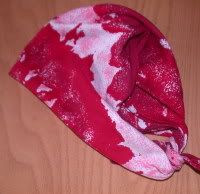 In the winter, when I most missed having hair: when lying down on my back, and the back of my head touched a cold pillow. I can't see my head (out of sight, out of mind) and putting on a bandana or scarf has comfortably replaced fixing my hair as part of my daily routine. But that cold touch on the back of my head got me every time.
While my head hair fell out after my first chemotherapy cycle, other facial hair waited until the weather got warmer. Now that cold pillows are no longer a concern:
- Not having eyelashes makes putting contacts in more of a challenge.
- I now need tissue for even the tiniest of sniffles. Not having nosehair, even the smallest amount of mucus runs straight out.
My husband baked cookies last week - and almost burned them. They're pretty hard, and he has apologized to me several times. The apologies were unwarranted, though: they turned out to be the perfect cookies for this week. Chemotherapy damages taste buds, and I have an aversion to sweetness. The cookies have had just enough of their sugar denatured that I can actually enjoy them. Anything that tastes good is precious to me right now, so hooray for almost-burnt cookies!
Humor has been a big help in keeping my spirits up. Following my first cycle of treatment, I was just feeling blah. My treatment regimen includes a high dose of steroids, and after I stop them I have a several day energy crash. "I don't feel good," I complain to my husband. He looks really concerned. "I've been thinking," he says. "Maybe you don't feel good because you have cancer." I laughed, as much as I could manage with my low energy. After that I felt a little better.
I am tired of eating Metamucil's fiber wafers. My daily dose of sugary, cinnamony, crunchy cookie goodness keeps my abdomen from causing me trouble, but it just gets hard to take eating the same thing day after day after day for four months now. I still have another few months of chemotherapy-damaged intestines, though, so Metamucil will get some more of my business.
I hope everyone is having a good Friday!
Monday, May 11, 2009
Beautiful
I was thrilled when my oncologist called my latest CT report 'beautiful'. He was very happy with how much the mass in my chest has shrunk.
Tumor size March 26, 2009 (measured by Dr. D):
* 6.7cm x 3cm on the axial projection (side to side & front to back)
* 5.3cm coronal measurement (top to bottom)
Tumor size March 26, 2009 (measured by Dr. C):
* 6.6cm x 3.9cm on the axial projection
* No coronal measurement given
Tumor size May 7, 2009 (measured by Dr. C):
* 4.3cm x 1.4cm on the axial projection
* No coronal measurement given
Since the tumor is still responding to the chemotherapy, we're going to do two more cycles, bringing my up to eight cycles total. Eight cycles will be it: one of the chemo drugs has a lifetime maximum dosage which I am close to (going over the lifetime maximum carries a high risk of heart failure). After I finish the chemotherapy, my oncologist said he'd like to send me to a lymphoma specialist to discuss whether or not I should do radiation.
From my own research, there is good evidence that radiation after chemotherapy reduces the risk of a relapse. However, it also carries risks of secondary cancers (because of my age, sex, and the tumor location, breast cancer would be of particular concern) and because my tumor is so close to my heart, heart damage from the radiation would also be a concern. It's not clear which option (rads vs. no rads) has a better risk/benefit analysis.
I know my doctors will make the best decision based on the evidence we have available. Regardless of which treatment plan we decide on, my chance of a cure will be good. And that's about all I can ask for.
Saturday, April 25, 2009
Morning birdsong
This morning I had my usual day 5 of cycle early a.m. insomnia. Laying in bed, deciding whether to get up or not, I heard a whippoorwill. I have never seen or heard one before, but the song was quite distinctive. And according to a short but seemingly well-referenced Wikipedia article, they are nocturnal birds whose range includes my location.
Hearing that song just made my morning.