Yesterday in Bible study, we came upon the topic of charity. A lively discussion ensued.
An example of a charitable cause was given; it was disputed that the cause was a charitable activity.
One person claimed that people who give nothing to charity miss the boat on an important moral obligation; another countered that we don't know everything people do with their money or what their reasons are and should not judge.
The tithe of 10% was brought up: this person believes that if we do not give 10% voluntarily, God will take it from us in unexpected ways. (And then the conversation drifted to how active God is in everyday life.)
There were some hard feelings generated during the conversation on charity; the sensitive nature of this topic took me by surprise. It's a topic I find very interesting and hope comes up again, with a caveat: that our group members can contribute to the conversation without generating any of the defensiveness I saw yesterday.
Diplomacy, please hang out with us all.
Sunday, May 22, 2011
Conversation on charity

Saturday, September 11, 2010
Happy New Year
I grew up in a town with a much higher Jewish population than my current city. On major Jewish holidays, there were generally multiple people absent from my school classes. Everyone was kinda aware of the holiday season.
Yesterday at work, three coworkers learned for the first time that I am a synagogue member. They kind of stumbled into it asking how my day off was: no clue that Thursday was the start of the Jewish New Year celebration.
At least I didn't go my husband's route, telling them that we all dress up in a giant dragon costume and set off fireworks indoors.
Sunday, February 7, 2010
Arcing
Yesterday morning, I was at Bible study. We started the sixteen verses that contain the ten commandments. Most of our discussion centered on Exodus 20:5-6, which follows the commandment against idolotry:
I, the Lord, your God, am a zealous God, Who visits the iniquity of the fathers upon the sons, upon the third and the fourth generation of those who hate Me, and [I] perform loving kindness to thousands [of generations], to those who love Me and to those who keep My commandments.The idea that innocent children should be punished for the sins of their parents, aside from being repugnant, directly contradicts other text in the Bible (e.g. Deuteronomy 24:16.)
One commentary put an interesting spin on the passage: perhaps it is not a statement of intent to punish. Rather, it could be an observation of the moral interdependence of parents and children. Children who are abused, for example, are at significantly elevated risk of becoming abusers themselves.
We also talked about the ratio of bad effects—three to four generations—to the "thousands of generations" for good effects. Does time really increase the amount of good in the world?
I remembered part of a quote from Martin Luther King, Jr, and looked it up when I got home:
The arc of the moral universe is long but it bends toward justice.It's a hopeful statement - bending toward justice. I find it kind of inspiring to think of the arc reaching back to Moses and the commandments. May we continue to guide the morals of our society toward justice.
Saturday, January 30, 2010
Wanna take a break?
Yesterday, a supervisor and one of my bosses asked me to join them: they were going for a cigarette break. I wasn't sure how to respond.
I have come to a point in my career where being a non-smoker is a (mild) impediment to further advancement. Not something I had foreseen, and not a welcome development.
On the other hand, I'm well-liked enough to be invited. I think that's a sign I should just keep doing what I'm doing. No tobacco necessary.
Saturday, January 9, 2010
Advertisement and body image
As I mentioned last week, I am spending a lot of time at Pogo. Pogo is an advertising-supported service. This means I have been watching a lot of advertisements.
In these ads, a common product is an expectorant. If you have a cough or sinus pressure, say the ads, take this product: it will get the mucus out. To dramatize the eviction, the ads anthropomorphize the mucus. Green people who live in our lungs or sinus cavities are shown riding motorcycles, swing dancing at clubs, having family reunions, or reading bedtime stories to their children. These green people are bad, imply the ads.
All the green people are obese. All the ill people—"good people" being harmed by the green folk—are skinny models. In addition to the "you don't have to suffer sinus pressure or a lingering cough" message, these ads are sending the message "take our product and you will kill the fat person inside you." It's absurd and disturbing at the same time.
Wednesday, August 12, 2009
History is powerful
I recently finished Battle Cry of Freedom by James McPherson, a history of the civil war. The narrative began with a highly abbreviated description of the Mexican-American war. A striking similarity to our present time immediately drew me into the story: one political party believed that use of troops had spread American freedom and democracy; the other believed American values would have been better spread by being a good example than by military force. The way differences over the Mexican-American war fed into increasing polarization on other issues also felt eerily familiar.
The political situation of the 1850s soon went well beyond our present-day experience, but it continued to tell a powerful story. The experiences of Americans during those years was vividly brought to life. My school history classes had focused on the outcome of the war; reading Battle Cry of Freedom taught me why it was fought in the first place, from the motivations of the leaders to the soldiers to the women and non-soldiers who supported the cause behind the battle lines.
I had been taught that of course the North won, it had a stronger industrial base. McPherson argues that the two sides were evenly matched. Having read through battle after battle where a chance event caused one side or the other to gain advantage, I'm convinced and awed at how easily the war could have gone the other way. I don't think I've ever before read a book that long (900 pages!), but it was a surprisingly easy read, and I'm glad did.
Sunday, March 22, 2009
Biopsy payment
When my tumor was biopsied in December, my insurance paid for the procedure at my local hospital, but not for the interpretation of slides done at the University of Iowa (which for some reason came as two separate bills). I called my insurance company, and was told the University of Iowa was out of network. That was discouraging.
I asked my oncologist's office about this, and they said, no, that wasn't right, they would resubmit the bills. A few days later, I got a slip from my insurance company that they were going to pay one of the bills. That was a big step in the right direction.
A few weeks went by with no word on the other bill, so Friday I called my insurance company. The agent was very confident that U of I was out of network, and that bill was not going to be paid. I pointed out the other bill (part of the same biopsy interpretation) that they had paid. No, she said, U of I was out of network, and they hadn't paid that. (!)
We went back and forth a few times, she insisting it hadn't been paid, me insisting it had. On March 3rd it was paid, I told her, find an action on that claim on March 3rd. February 18th, March 2nd... then she found March 3rd. There was silence for a minute. I was really afraid she was going to find something to un-pay it.
Then a light bulb must have gone off. "Did you go to the University of Iowa?" No, my biopsy was done at my local hospital. Only the slides were sent to U of I. Well, that was entirely different. Of course they would pay. She apologized for the trouble they had caused me.
Good news, but how bizarre. I would have thought the thousands of dollars in hospital bills would have clued them off that I was in my local hospital that day. Or that the procedures being billed from U of I would have obviously been done on slides, not an actual person. Considering all the money that passes through their system, health insurance does not seem as with-it as one would hope.
Sunday, December 14, 2008
Body modification
Friday, two of my coworkers were talking about how awful it was that their children wanted body piercings. It just wasn't "right" to have a hole in your eyebrow or nose or belly button.
It's an attitude I find odd, that there's some "correct" physical appearance. I've come across it in with respect to animals, too: people horrified that I clip my birds' wings; owners of dogs and cats who do not confine their pets, but believe sterilizing them would be "wrong".
Maybe it's not so odd, though. I could not support a person cutting off a toe because they preferred the appearance of a four-toed foot; I oppose declawing of cats. There is, it seems, no simple rule on where to draw the line on body modification.
Sunday, October 19, 2008
Powell on Islam
This morning, one of the threads I read on Ovusoft was about Colin Powell's endorsement of Barack Obama's bid for U.S. President. Apparently, during his interview, Powell brought up the mistaken belief that Obama is Muslim, and refuted it, then went on to say:
But the really right answer is: What if he is? Is there something wrong with being a Muslim in this country? The answer's no, that's not America. Is there something wrong with some 7-year-old Muslim American kid believing that he or she could be president?
He also told the story of this mother, whose son died while serving in the U.S. army:
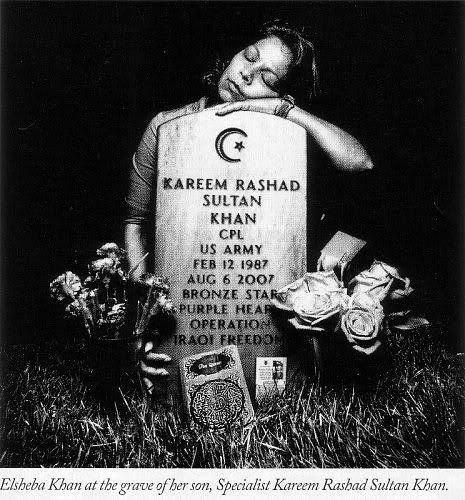
Yesterday, a Muslim poster on Ovusoft expressed fear of being attacked for voting in two weeks: she wears a hijab and is readily identifiable as Muslim. Extremists in the U.S. have, for whatever reason, decided their message spreads well during this election season, and it is disheartening. I was really impressed that Powell took this opportunity to make a statement against hatred. I pray the American people take his message to heart.
Sunday, August 17, 2008
Preening
My birds spend hours and hours every day preening. Run a beak along a feather. Run a beak along another feather. And another. Then fluff. Pick a new spot, repeat. Even bringing them into human civilization, where finding food and staying warm aren't concerns, just maintaining basic health requires an amazing amount of time.
To some extent, the same thing is true of humans. And I resent it. Time spent exercising. Brushing and flossing. Even the time required to shower, I resent. And why? Somehow I have this idea that I need to be doing fulfilling things with my life, and time spent on mundane tasks is time spent unfulfilled.
My birds don't seem to resent the preening, though. In fact, I bet the only reason they do it is because they find it enjoyable. Fulfilling, even, if I could anthropomorphise that far. I try to take it as a reminder that life is about living, enjoying the daily routines. Learning about exotic phenomena, pursuing novel tastes or sights or experiences, or trying to better the world are novel ways humans have found of being fulfilled in life. But they don't have to exclude finding fulfillment in the mundane.
Saturday, August 9, 2008
Not-so-light reading
A while back, a fellow Wikipedia editor recommended to me the Summer/Fall 2007 issue of the Josephinum Journal of Theology. I just got my copy a week ago, and finished it today. Despite the density of the writing, some of which I couldn't even start to follow, it was a fascinating and informative read.
The degree of dissent in the articles really surprised me. Some things in Catholic teaching I had thought were "established": John Paul II's Theology of the Body, for example. Well, I was wrong. While JPII's teachings were a central topic in several of the articles, criticism slightly outweighed acceptance.
I suppose the dissent shouldn't have surprised me: the whole point of being a theologian is to publish novel ideas in one's field. Claiming a novel idea is true means that previous ideas were at best inadequate, and at worst completely wrong.
Even inadequate and incorrect ideas provoke discussion, though. Discussion to resolve disputes is an important part of how human knowledge grows.
Monday, August 4, 2008
Spinach: not like on Popeye
Two of my coworkers have commented on being beaten up as children due to Popeye: they experimentally proved that eating spinach does not enable one to win fistfights. They both have pretty low opinions of spinach as a food.
Which is a shame, because spinach is a rich source of vitamins and minerals and healthful phytochemicals. Since I became vegetarian, I have struggled with low iron levels. If I eat spinach every day (say, on a salad, amounting to 5-10% of the USDA recommendation for iron intake), I never get rejected from donating blood.
I don't like spinach enough to eat it most days. So I take an iron pill (150% of the USDA recommendation for iron intake) five days a week. However, if I don't supplement that with spinach or other leafy greens a few times a week, I still get rejected from donating blood.
Pills just can't compare to food as a nutrition source. That seems to be part of the message Popeye's creators intended to send. But by exaggerating the effect, their strategy may have backfired, turning off a large number of people from appreciating what food does for us.
Thursday, July 31, 2008
Emergency pricing
If a person calls a plumber on the weekend or the middle of the night, they are generally charged a higher rate than for daytime plumbing. This encourages people to do whatever they can to allow the plumber to work during normal business hours. It compensates plumbers for unexpected loss of their time with family. It's a hardship on people who have truly unforeseen emergencies, though.
If a tree company cancels all of their scheduled work for two weeks and has its crew work long hours and weekends removing trees from houses: is charging three times their normal rate reasonable compensation? My neighbor and coworkers were rather shocked at the quotes we got for tree removal; accusations of gouging were made. A lot of people removed trees themselves or found non-professionals to do the work; this took a lot of the burden off the tree companies and the storm damage through the city was cleaned up faster.
I can see where it is unseemly to make money off of the hardships of others. But when a person needs an emergency service, providers of that service are not obligated to donate their time and expertise charitably. It's a fine line between reasonable emergency rates and gouging.
Tuesday, July 29, 2008
Sympathy quotient
Conversations during the first part of last week were an interesting experience. I wanted to talk about the damage on my property and our loss of trees, and about the downed trees in our neighborhood. This elicited a lot of sympathy from people in unaffected areas - both far away (like the national claims office for our insurance; our mortgage company) and nearby (my mother in law and rabbi).
If I brought up the subject to people who were affected, I was regaled with tales of going three days without running water (no electricity to run their well), trees on cars, people maybe without property damage but a half dozen mature trees downed in their yard and requiring removal. One member of our congregation had no damage with this storm: when I mentioned the tree on our house (it broke off the eaves), he related his experience with a tree taking out his porch and kitchen ten years ago.
Not knowing who was affected and who was not, it was kind of jolting to go into a conversation expecting to receive sympathy and ending up being on the giving end. My outlook changed based on how recent conversations went: having people feel sorry for me narrowed my focus to my own problems. Talking with people significantly worse off than myself really steered my thoughts towards others.
I hadn't realized how significantly my social interactions shaped my views.
Sunday, July 20, 2008
If only spirits of the law could talk to us
Yesterday I spent a few minutes playing my electric keyboard. I took a break, and read the paragraphs on correct playing technique my organ teacher had assigned me. One of the instructions about hand position did not make any sense to me. I thought perhaps it would be useful to people at more advanced levels of skill, but was probably not important for me right now.
I played a little bit more, and noticed my pinky finger was hurting. I looked at how I was pressing the keys, and thought about exactly what was causing my finger to hurt. I changed my hand position to that described in the technique book, and the pain in my pinky stopped. I should have had more respect for the author of that book.
But I believe it is reasonable to be wary of following rules I don't understand. For one thing, such blind rule-following impacts me negatively at work. I've had college training as an engineer, and worked with engineers at our customers. If a part we process fails to meet its specifications, I have a general idea about whether it is still a functional part.
Not true for a few of our customers, who not only don't understand the reasons behind the specifications, but are not interested in learning them. They will insist we either rework the part to meet spec (not always possible, and a waste of time and money if the part is perfectly good as-is) or pay to replace it (again, what a waste if the only thing wrong with it is a technicality).
I have no desire to provide bad work to any of our customers. Unfortunately, having a customer that is a blind rule-follower makes it very tempting to rely solely on the judgment of my own company on whether an out-of-spec part is still fully functional. Not offering the customer the opportunity to make their own evaluation increases the risk of a part failure.
Ideally, everyone would understand the reasons behind every rule. Furthermore, they would be able to ignore the rules in situations where the "spirit of the law" does not apply, and never be skeptical of the rule in applicable situations.
This can't happen in the real world; we just don't have time to research the reasoning behind every rule we encounter in our lives. We often use the heuristic of evaluating our trust of the rule's source, following rules for sources we trust and ignoring rules from sources we lack faith in. Without such heuristics, humans couldn't function, especially in today's complex society.
But "appeal to authority" is a logical fallacy. That and our other heuristics inevitably have failures. Experiencing such failures can lead to a skepticism of all regulations: and then we fail to follow beneficial rules. I hurt my pinky yesterday. Sometimes the consequences are a lot more serious.
Thursday, July 10, 2008
Jumping on the modesty bandwagon
Back in January, Aunt B. posted on Tiny Cat Pants about women's negative experiences in math class (unrelated to the math). The comments went off topic into a discussion of how men react to women's clothing. In May, Jen from Et Tu? posted a survey that was intended to determine which women's fashions cause men to struggle with chastity. At the beginning of this month, Veronica at Toddled Dredge posted about her experience with prioritizing a modest appearance. And then yesterday, I got the July issue of the Couple to Couple League's newsletter. It has a four-page article on teaching girls to dress modestly.
Apparently, this is a hot topic. (Although one may view my taking four articles over a six month time frame as evidence of "hot topic" status as proof of my limited reading material.) But there appear to be a significant number of people who miss the culture-specific nature of this message. The CCL article interviewed a woman who said, "But in the end, it all comes down to... Cover it up." This ignores the issues of comfort and freedom of movement that are legitimate reasons for wearing lower cut necklines in hot weather or pants (that show the shape of the legs) over skirts (which, when tight, restrict movement, and when loose, get tangled in certain work and sporting environments). And the fact that "it" is going to be different in different cultures: in ours, "it" is buttocks and busts, while in other cultures "it" is hair, or arms, or toes and ankles.
There are also many who claim that women's dress is the primary factor driving certain men's struggles with chastity. Which I can dispute just by observing my parrots. The cockatiel (male) seems quite happy to lead a celibate life as my pet. However, it is a struggle for the budgerigar (parakeet). He sexually harasses the cockatiel (the target of his affections is the same sex and a species three times his size) to the point that we have to separate them for several hours every day. Denied intimacy with another bird, the budgie then finds a mirror and engages in self-stimulation. Lest we think this behavior is limited to non-human animals, consider this comment:
Recently, on the Alan Colmes Show on Fox Radio, the host asked radical antiabortionist Neal Horsley whether it was true he had sex with animals in the past. Horsley replied: "Absolutely. I was a fool. When you grow up on a farm in Georgia, your first girlfriend is a mule." If that surprises some people, he added, "Welcome to domestic life on the farm. You experiment with anything that moves when you are growing up sexually."
So, my thoughts on women's clothing and men's struggles with chastity: they're only weakly related. However, that doesn't mean women should not dress "modestly". Clothing choices send a culture-specific message about how a woman views herself and how she wants others to view her. By choosing clothing her culture considers modest, a woman sends the message that she values herself apart from her sexuality, and that she does not want others to treat her as a sex object. Which I think is an important message, and the CCL article actually focuses mostly on that aspect (I intend to write them a letter thanking them for that approach). One can be modest without blaming women for the nature of men.
Tuesday, July 1, 2008
Sleep randomness
To me, sleep in a fascinating topic. Over the past few years, I've collected some random factoids about it.
On his most recent appearance on the The Daily Show, Bill Clinton talked about sleep among federal legislators. He believes that legislators now get significantly less sleep than legislators did when Clinton first entered politics. He blames this on certain technological advances and cultural shifts. Clinton believes a significant part of the animosity on Capital Hill is (to paraphrase Stewart's paraphrase of Clinton) due to them being cranky because they missed their nap.
Marine mammals (whales, dolphins, etc.) are not born able to breathe in their sleep. (Breathing being more complicated when you are an air breather who lives underwater.) For the first few weeks after birth, neither mother nor baby sleeps a wink, then they gradually work their way up to normal amounts of sleep. The fascinating thing: the mothers do not show any signs of sleep deprivation during this time.
Over the past several years, the science magazine I read has published stronger and stronger evidence linking childhood obesity to lack of sleep.
Normally I would seek links to support these claims of mine. This would allow any interested readers to easily find more information on each topic. And I have more than once gone looking for a supportive link only to find my information was dead wrong. But this post will have to stay as bald assertions, because it's my bed time.
Friday, June 27, 2008
What goes in a lawn
I think most people view lawns as areas of grass, and (ideally) nothing else. There is a certain aesthetic appeal to an uniform expanse of green.
For the past month, as I drive around I see many yards with the little white balls that are clover flowers. The feed stores near us do sell clover seeds right beside the grass seeds, so in some yards this may be intentional. In many lawns, however, these flowers stop exactly at the property line. It's rather obvious which houses are using herbicides.
Which, you know, if they dislike the variegated green of yards with clover (and other plants), and don't think the white flowers are pretty: these are subjective opinions. One can't really argue with that.
I don't like the idea of heavily chemicalled lawns (they can cause serious environmental problems). With city weed ordinances and restrictive HOA covenants seeming to be everywhere, though, I often feel like I'm in the minority. But driving around and seeing half the houses with the little clover flowers: perhaps society is moving away from the idea of lawn as a monoculture, after all.
Friday, June 20, 2008
The marital act
My earliest memory of discussion premarital sex is with a lab partner in seventh grade. Somehow the subject had come up, she asked me if I believed in premarital sex. I said I did. She was very surprised, asked me if I thought I would have sex before I was married. I said I would. I was honest in my answers, but don't remember taking the subject very seriously. I think I looked at it kind of like going to church: I went some weeks, but not every week, and other people did the same. Some people didn't go at all, and that was OK, too. Some people waited until marriage to have sex, and some didn't, whatever worked for them.
One of the few other times I remember hearing the subject talked about was with a couple of guys in my twelfth grade English class. One asked the other if he was waiting for marriage, which the other guy was. The first guy was very surprised. Somehow this interaction made me think the wait-until-marriage attitude was more common than I thought. But it still seemed like a religious ritual that was meaningful to some people, but not useful for others.
During my sophomore year of college, I attend several programs that were part of "Sexual Health Week". One of them was a presentation on how body language contributed to relationships. The presenter talked about hugging, told a story about his son getting really excited about something and kissing his dad (the presenter) on the cheek, discussed the chest-bumps sports players give each other after a good game. I don't really remember how he presented things, but I remember it was making a lot of sense to me. Near the end of the presentation, he drew a graph, a line from the origin up and to the right, with an 'X' at the end. I do not recall what the axis were supposed to represent. He didn't explain the 'X', it was kind of done on the side, but it was obvious that it represented marriage and sex.
My jaw did not actually drop, but that's pretty much how I felt. That there could actually be a logical, completely areligious reason to limit sex to marriage was a shock to me. It didn't convince me to renounce my intimate activities, but it certainly made me more open to the Catholic arguments along these lines. (I'm fairly certain the presenter was Catholic.) Fascination with Catholic sexual teachings, and practice of fertility awareness, remain important aspects of my life today.
Monday, June 2, 2008
Racial tension
While my father attended graduate school, I attended an elementary school that bussed its (primarily white) students, in either fourth or fifth grade, to a school with a primarily black student body. The year before my turn to be bussed, our class was given a tour of the school we would be attending the next year.
Near the end of the tour, for some reason I volunteered that I would not be going to this school: my family was moving. The teacher seemed upset and said she really wished my parents would reconsider. I was confused by her reaction, but didn't pursue the subject. Looking back, I'm sure she thought our move was purposed to avoid my attending school with black children. Really, I don't think my parents could have cared less about the busing: we were moving because my father had graduated and gotten a job.
My next memory of racial tension is several years later, while helping with a summer day camp program at my church (Vacation Bible School). I was responsible for moving one of the classes (around five years old, I think) from teacher to teacher for the programs, and for supervising them during play time. There was only one black child in the group, a sweet little girl, and she took a liking to me. Until she thought I based a decision she didn't like on her skin color. Each time that happened, she wouldn't talk to me for some length of time. Some of her hurt feelings were obviously the misunderstandings of a five year old, but others really made me wonder: was I subconsciously favoring children who looked like me?
Now, when interacting with a black person I don't know, I am very aware of how my actions might be perceived. During a layover on my recent trip, I spent some time watching the news at one of the TVs scattered around the airport. It was near the time I needed to move to my gate, and a black man sits down next to me. I felt quite bad getting up and leaving right away, afraid the impression I left is that I didn't want to sit next a person of his skin color. How would he know my plane was boarding soon?
My limited experiences comprise only a tiny piece of the racial tension in our society. But even removed at such a distance from the severe effects of this tension: what a mess.