Monday, September 1, 2008

Kosher: current issues

Most people have a strong preference for laws that make sense. While religious rules may start with a different set of assumptions than secular rules, they still, generally, have a reasoned explanation much beyond, "because God said so." One exception in Judaism is the laws about kosher food. As one commentator explains:

The historical origin of the Jewish dietary laws is obscure and so is their rationale... the kashrut of the Bible belongs to that corpus of law we term "hukkim" (statutes) and for which no rationale is apparent. Biblical commentators have suggested hygiene, or religious separateness, or discipline as possible reasons for the enactment and observance of kashrut, but these and other equally plausible suggestions are not sufficiently supported by historical evidence to emerge from the realm of conjecture.
The lack of obvious rationales is a big reason practicing kosher is optional in Reform Judaism. However, many people the rules were at least partially ordered toward being humane. For example, the Biblical command, "You shall not boil a kid in its mother’s milk" is repeated three times. From the Union for Reform Judaism:
Any kosher animals must also be slaughtered in a kosher way, which is an ancient slaughtering process that is believed to be less painful for the animal.
The recent issues in Postville have highlighted how the traditional rules not only fail at accomplishing humane treatment for animals, but don't address the equally (if not more) important issue of humane treatment for human workers at kosher slaughterhouses. The Conservative Jewish movement recently started a new committee: it is tasked with creating a new certifying process for kosher foods. This certification will takes into account ethical considerations for workers and animals in addition to ritual laws. The Reform movement just passed a resolution to support this new certification process.

The partner and I, like most members of Reform congregations, do not keep kosher. But we will definitely be looking for products certified under the new regulations: improving the ethics of our food purchasing speaks to how we want to practice religion.

Sunday, August 31, 2008

A flying trespasser

My partner woke me up at 11 o'clock last night to let me know there was a bat in our house. "I didn't scream this time," he reported to me.

So we're going through our house, him holding a towel and closing doors behind us, me trying to open the windows of the rooms the bat has flown into. After opening one of these windows, I found my face inches from a quarter-sized peach-colored spider with a web that filled the whole window frame. Yikes.

Now, our house is 90 years old. All the windows are original, and amazingly, they all open. Only on one window have the ropes even broken. We opened the weight pockets to repair the ropes, and never got around to closing them.

So of course, the bat lands on the one window in the house with open weight pockets, and crawls right inside. It was probably a very comforting place to hide from people chasing it with towels and turning on bright lights everywhere it flew.

We cleared the window of the spider web (the spider had scurried off, fortunately), and then taped some clear plastic sheeting over the inside of the open window. Hopefully, sometime last night, the bat crawled out of the weight pocket and flew outside.

The bat was small and furry and completely non-aggressive. And it was neat to see how it could crawl using its wings; they're not like bird wings that are useful only for flying. The other time we found a bat in our house (3 years ago), it used its wings to cling to a 2x4 while I carried it outside. But I would have preferred to only experience that cuteness in a zoo, and not in my house.

Monday, August 25, 2008

Pornographic theology

I found some of my reading in the Josephinum Journal of Theology to be uncomfortably explicit. The theologians are trying to tease out certain aspects of the unitive meaning of sex. Which requires examining rather intimate accounts of people's orgasms.

I can see how this position is logical: the pleasure involved in sex is a large part of what releases the oxytocin that causes the unitive effect. Exploring the unitive aspect of sex thus requires acquiring an understanding of the pleasure people derive from it.

Which I have difficulty with. My writing about birth control and the mechanics of inserting a diaphragm is one thing; people writing about their experiences of orgasm is an entirely different plane of intimacy. The writers tried to be clinical about their presentation. But it really struck me how close they were to requiring pornographic material to advance their theology.

Sunday, August 24, 2008

Routine shake-up calms things down

You know your housekeeping is sub-par when your broom has spider webs on it.

I don't think my cleaning standards have gone up in the three weeks I've been doing the no-computer-on-Saturdays experiment. But I feel like I'm more on top of my old schedule, no longer in a place where minor disturbances to my routine will throw all of my plans out the window.

Starting organ lessons has also had a noticeable effect: the lesson is once every two or three weeks, and I'm trying to practice for at least an hour, at least three times a week. My weekday computer time has fallen off quite a bit.

I miss working more on Wikipedia articles. I miss typing out blog-type thoughts more often. But I feel distinctly more at peace with my routine than I have in a very long time. Jen at ConversionDiary once quoted Fr. Ciszek as saying, "God's will can be discerned by the fruits of the spirit it brings, that peace of the soul and joy of heart are two such signs."

I'm not convinced about the God's will part, but these moves have a very "right" feel to them. Peace.

Sunday, August 17, 2008

Preening

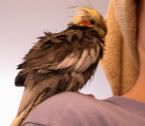
My birds spend hours and hours every day preening. Run a beak along a feather. Run a beak along another feather. And another. Then fluff. Pick a new spot, repeat. Even bringing them into human civilization, where finding food and staying warm aren't concerns, just maintaining basic health requires an amazing amount of time.

To some extent, the same thing is true of humans. And I resent it. Time spent exercising. Brushing and flossing. Even the time required to shower, I resent. And why? Somehow I have this idea that I need to be doing fulfilling things with my life, and time spent on mundane tasks is time spent unfulfilled.

My birds don't seem to resent the preening, though. In fact, I bet the only reason they do it is because they find it enjoyable. Fulfilling, even, if I could anthropomorphise that far. I try to take it as a reminder that life is about living, enjoying the daily routines. Learning about exotic phenomena, pursuing novel tastes or sights or experiences, or trying to better the world are novel ways humans have found of being fulfilled in life. But they don't have to exclude finding fulfillment in the mundane.

Sunday, August 10, 2008

Religion and food science

One of the big research areas in longetivity is calorie-restricted diets. No studies of continual calorie restriction have been done in humans (I think it would be deemed unethical). Interestingly, a study in rats found that regular fasting (with no calorie restriction on non-fast days) had similar health benefits to calorie restriction. Fasting would in many ways be more practical to implement in humans than continuous calorie restriction.

Encouragingly, a human study of Mormons (who are encouraged to fast the first Sunday of each month) concluded this once-a-month fast lowered their risk of heart disease by 40%. That benefit persisted even after accounting for differences in weight, age and conditions like diabetes or high cholesterol or blood pressure.

So, I've become interested in fasting. Today is Tisha B'Av, one of the two major fast days for Judaism. I fasted on the other major fast, Yom Kippur, earlier this year. The proscription is no food or drink. But while the science has interested me in trying the no food part, I don't current see any benefit to risking dehydration: I'm drinking water and tea.

While I am sometimes put into a horrible mood by eating a meal late, my two experiences with fasting I have not felt anything other than mild hunger. It doesn't feel very religious, just not bothering to cook or eat anything. Other religious practices have become more meaningful to me with repetition, though. It will be interesting to see if this one grows on me, also.

Saturday, August 9, 2008

Not-so-light reading

A while back, a fellow Wikipedia editor recommended to me the Summer/Fall 2007 issue of the Josephinum Journal of Theology. I just got my copy a week ago, and finished it today. Despite the density of the writing, some of which I couldn't even start to follow, it was a fascinating and informative read.

The degree of dissent in the articles really surprised me. Some things in Catholic teaching I had thought were "established": John Paul II's Theology of the Body, for example. Well, I was wrong. While JPII's teachings were a central topic in several of the articles, criticism slightly outweighed acceptance.

I suppose the dissent shouldn't have surprised me: the whole point of being a theologian is to publish novel ideas in one's field. Claiming a novel idea is true means that previous ideas were at best inadequate, and at worst completely wrong.

Even inadequate and incorrect ideas provoke discussion, though. Discussion to resolve disputes is an important part of how human knowledge grows.