To me, sleep in a fascinating topic. Over the past few years, I've collected some random factoids about it.
On his most recent appearance on the The Daily Show, Bill Clinton talked about sleep among federal legislators. He believes that legislators now get significantly less sleep than legislators did when Clinton first entered politics. He blames this on certain technological advances and cultural shifts. Clinton believes a significant part of the animosity on Capital Hill is (to paraphrase Stewart's paraphrase of Clinton) due to them being cranky because they missed their nap.
Marine mammals (whales, dolphins, etc.) are not born able to breathe in their sleep. (Breathing being more complicated when you are an air breather who lives underwater.) For the first few weeks after birth, neither mother nor baby sleeps a wink, then they gradually work their way up to normal amounts of sleep. The fascinating thing: the mothers do not show any signs of sleep deprivation during this time.
Over the past several years, the science magazine I read has published stronger and stronger evidence linking childhood obesity to lack of sleep.
Normally I would seek links to support these claims of mine. This would allow any interested readers to easily find more information on each topic. And I have more than once gone looking for a supportive link only to find my information was dead wrong. But this post will have to stay as bald assertions, because it's my bed time.
Tuesday, July 1, 2008
Sleep randomness

Sunday, June 29, 2008
A matter of perspective
On Wikipedia, I feel my best work is done in collaboration with other editors. But many of the articles I work on, no one else is working on. There is topic coverage that would not be on Wikipedia if I did not contribute. There are subjects that were peppered with misinformation (that in some cases had been there for years) before I corrected them. Especially with my recent discovery of an article hit counter (some articles I work on get thousands of page views every day), it's easy to feel that I am single-handedly improving the world's knowledge base.
But the English Wikipedia is near 2.5 million articles. While it suffers from chronic poor writing quality, it has depth of information not available anywhere else. Accuracy is spotty, but apparently good enough for people to use it in droves. Wikipedia has been blamed for the demise of a French encyclopedia, and is viewed as enough of a threat that other encyclopedias (another French one, and the the Encyclopedia Britannica) are imitating its writing model to try to compete.
My contributions to the project are an infinitesimal part of that picture. Even if I'd never made so much as a spelling correction, Wikipedia would still be in the vaunted position it is today. It's an odd feeling, to see my work as both hugely meaningful, and as completely insignificant.
Friday, June 27, 2008
What goes in a lawn
I think most people view lawns as areas of grass, and (ideally) nothing else. There is a certain aesthetic appeal to an uniform expanse of green.
For the past month, as I drive around I see many yards with the little white balls that are clover flowers. The feed stores near us do sell clover seeds right beside the grass seeds, so in some yards this may be intentional. In many lawns, however, these flowers stop exactly at the property line. It's rather obvious which houses are using herbicides.
Which, you know, if they dislike the variegated green of yards with clover (and other plants), and don't think the white flowers are pretty: these are subjective opinions. One can't really argue with that.
I don't like the idea of heavily chemicalled lawns (they can cause serious environmental problems). With city weed ordinances and restrictive HOA covenants seeming to be everywhere, though, I often feel like I'm in the minority. But driving around and seeing half the houses with the little clover flowers: perhaps society is moving away from the idea of lawn as a monoculture, after all.
Tuesday, June 24, 2008
A secret spice
Last month, we went out to dinner at a fancier restaurant than usual. It was our fifth wedding anniversary. We discussed ordering an appetizer, and I asked my partner what he would like. He told me I should get whatever I wanted, because my menu options were so scarce (I am vegetarian).
It struck me as odd that my vegetarianism was seen as a burden. True, he, as an omnivore, had the choice of a few dozen delicious-sounding dishes. While I had the choice of three or four very appetizing dishes. I pointed out that, according to Schwartz's The Paradox of Choice, my smaller menu should make me happier with my food. Which, after reading the book, I think is true: I savor good food more now than I did before restricting myself to a vegetarian diet. But, it's not something I would have realized on my own. Self-denial is not an intuitive pathway to satisfaction with life.
In a typical week, I cook for us three times, we eat out two or three times, and our remaining meals we fend for ourselves around the house. On those nights, my partner and I often struggle with what to feed ourselves. He commented yesterday that the angst of selecting from all the food in our house was perhaps not worth it, "If all I had was wheat berries and water, I would know what I was having for dinner."
I hadn't realized this was one reason he liked my cooking. It's not just the meal preparation I do for him, it's restricting his options for dinner. I cook it, he eats it. And savors it more than he would if there were other options.
Sunday, June 22, 2008
Footwear
My mother taught me cross-stitch when I was five: I could not draw the letter 'X' and she thought the structure of the canvass would help my spatial skills. I have enjoyed needlework every since. As nifty as handmade items are, however, it's difficult to find a project that would be useful. We don't need more pictures to hang on the walls, we have enough sweaters and blankets and hats and gloves and scarves.
Many of the women in my knitting group make baby clothing. Babies always need new clothing, plus they're small, so these projects go relatively quickly. Not having any babies in my immediate family, I've found myself attracted to another popular item in this group: socks.
I have to get a few new pairs every year my old socks develop holes, and socks are worn all year round. Also, they are a medium-sized project that keeps me busy for many weeks, but doesn't seem like a never-ending task. And, there is a definite advantage to handmade over machine-knit socks: the heel.
The placement of the heel is custom to my foot, where mass-produced socks in my size run a little big on me. Even more exciting, though, the heel is actually square. The sharper angled heel stays in place on my foot much better, making the sock more comfortable and less likely to twist around if I wear it to bed.
The striped sock I made, the plain sock I bought at Target or somewhere similar. The toes on handmade socks are also different, but these don't seem to affect their comfort, only their appearance. The pictured sock is part of only the second pair I've ever made, but I think the benefits of handmade heels will keep me coming back to sock projects for many pairs to come.
Friday, June 20, 2008
The marital act
My earliest memory of discussion premarital sex is with a lab partner in seventh grade. Somehow the subject had come up, she asked me if I believed in premarital sex. I said I did. She was very surprised, asked me if I thought I would have sex before I was married. I said I would. I was honest in my answers, but don't remember taking the subject very seriously. I think I looked at it kind of like going to church: I went some weeks, but not every week, and other people did the same. Some people didn't go at all, and that was OK, too. Some people waited until marriage to have sex, and some didn't, whatever worked for them.
One of the few other times I remember hearing the subject talked about was with a couple of guys in my twelfth grade English class. One asked the other if he was waiting for marriage, which the other guy was. The first guy was very surprised. Somehow this interaction made me think the wait-until-marriage attitude was more common than I thought. But it still seemed like a religious ritual that was meaningful to some people, but not useful for others.
During my sophomore year of college, I attend several programs that were part of "Sexual Health Week". One of them was a presentation on how body language contributed to relationships. The presenter talked about hugging, told a story about his son getting really excited about something and kissing his dad (the presenter) on the cheek, discussed the chest-bumps sports players give each other after a good game. I don't really remember how he presented things, but I remember it was making a lot of sense to me. Near the end of the presentation, he drew a graph, a line from the origin up and to the right, with an 'X' at the end. I do not recall what the axis were supposed to represent. He didn't explain the 'X', it was kind of done on the side, but it was obvious that it represented marriage and sex.
My jaw did not actually drop, but that's pretty much how I felt. That there could actually be a logical, completely areligious reason to limit sex to marriage was a shock to me. It didn't convince me to renounce my intimate activities, but it certainly made me more open to the Catholic arguments along these lines. (I'm fairly certain the presenter was Catholic.) Fascination with Catholic sexual teachings, and practice of fertility awareness, remain important aspects of my life today.
Tuesday, June 17, 2008
Making small tasks easier
At work, many times a day, I attach a tag to a customer's container. Our shipping department uses the tags, so they need to be readily visible. Many of the containers are perforated, or have bands around them, or nails sticking out, or there is a handy tag-holding device on the container. Sometimes, though, there is no good place to attach a tag.
One of my co-workers has a Leatherman multi-tool. He uses the awl to poke a hole in problematic containers (for threading the tag wire through). When I first with my current company, I would try to imitate this hole creating method with my pens. I kept breaking my writing utensils. I thought about getting my own multi-tool, but it was quite bulky - my coworker has a special holder he wears on his belt. I don't wear a belt to work.
Then I found this: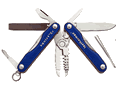
It's small enough I can carry it around on my keychain:
And now I, too, can easily make holes in our customer's containers!
It is also quite handy for retrieving packing lists, opening boxes, acting as a readily available light screwdriver or pliers, a lever in tight places, and more. The main drawback is that the knife is not locking, which is a safety concern. But for the amount I use it and the small size, this is a fantastic device.
I recently discovered an indispensable home use for this mini multi-tool. Small spice containers have long been a challenge for me to open. "Push here" they say:
If only it were that easy. I've broken the opening into bits (which fall into the container), managed to pop the thing open in one piece (only to have the entire thing fall inside the container), sliced open the entire top of container with a knife... success eluded me.
Until I tried out one of the screwdriver attachments from my mini-tool. It not only popped out the opening bit, but was thin and small enough I could pull out that bit of plastic and not having it floating around with the spices! Oh, the joy of attaining victory over the spice container.