
Time for the cyclamen to come out: I turned the pot upside down and started shaking. Shake, shake. Shake, shake. No movement. I stared at the roots coming out of the bottom of the pot, wondering if they were stuck inside. I was afraid to pull on the plant top: cyclamen stems are fragile. Shake, shake - it was loose!
I eased the rootball out of the pot and started prying it apart. I think I was expecting bulblets that would peel off. What I actually found was a solid mass, about the size and shape of a small donut. What was this? Could it be divided? Off to the internet.
Cyclamens have corms, which can be divided, but not by pulling apart with fingers. They require a sharp knife. So, paring knife fetched from the kitchen. I cut the tuber like a cheese wheel. Each wedge into a pot, add my prepared potting mix. All done - plants back to the kitchen window with a fresh watering, supplies put back away.
And wait. Plants don't always take well to having their roots messed with. Taking a sharp knife to a living thing and cutting it into pieces seems an illogical way to promote its health.
I come downstairs this morning, into the kitchen for breakfast: the windowsill has four perky-looking plants. They seem happy in their new homes. I'm happy I could do that for them.
Now I have four cyclamen plants, only one of which I intend to keep. All with flower buds. Three to give away. So, who needs a new houseplant?
Saturday, January 1, 2011
I cut a corm

Friday, December 24, 2010
Would you like to restart your computer now? YES!
Yesterday, I broke my mother-in-law's computer. When turned on, it would show the Dell logo, then a cursor would blink a few times. Then blackness.
An hour later, after much rebooting and Windows startup repair utility failing - twice - I managed a system restore to a point before I broke the computer. And then I spent another hour reassuring my mother-in-law, and fixing the things I had gone over there to fix: installing a new mouse (the LED in her mouse had burned out - who ever heard of that happening?) and removing expired antivirus software.
The cause of the breakdown? When prompted "would you like to restart now?" after installing software for the new mouse, I said "no". And then I uninstalled the expired antivirus software, which also required a restart. Only, after doing those two things with no restart in between, the computer was no longer able to boot.
I have never before broken a computer that severely. It was especially scary because I did it to someone else's machine. Yikes.
Moral of the story: if your computer wants to restart, SAY YES!
Sunday, December 5, 2010
Lactose and osmotic pressure
Since college, I have had some issues with lactose intolerance. My degree of tolerance has seemed to go up and down, which is puzzling and frustrating. After a recent bout, I decided to do some reading on the subject to try to gain more understanding of (and more control over) my situation.
I started with a Google search. After reading several webpages, the information was all starting to sound the same. Until I got to Wikipedia: "lactose... raises the osmotic pressure [in] the colon."
Osmotic pressure? I think I learned about that in ninth grade... I had to click through the wikilink to figure that one out. So, having something that cannot cross a semi-permeable barrier (gas and other by-products made by lactose-eating bacteria cannot cross the intestinal wall) causes water to cross the barrier (making watery, um, colon contents).
It looks like the unchangeable part of lactose intolerance is lactase deficiency: the inability to digest lactose in the small intestine. So the lactose travels down to the large intestine, where it is eaten by bacteria. At that point, the degree of symptoms (or even if there are any symptoms) depends on the behavior of said bacteria: how much gas and "increased osmotic pressure" they produce while eating lactose varies widely from bacteria species to bacteria species.
So I can eat cheesy pizza one week, and have polite bacteria that dispose of the lactose without causing me any trouble. The next week, not-so-polite bacteria cause me to seriously regret that cheesy lentil and leek loaf. How to encourage the polite bacteria to keep up residence? There seems to be a feeling that eating the same amount of lactose every day can help, but nobody really knows. So I haven't actually gained any more control from my reading.
But at least I can laugh while thinking about my situation as a problem with "osmotic pressure." Thanks, Wikipedia.
Saturday, November 6, 2010
New line of communication
At work, I may call a customer without knowing who I need to talk to. Sometimes I have notes from coworkers or predecessors, extension numbers and names that are useful. Sometimes the notes are hopelessly out of date. Sometimes there are no notes. Regardless, after navigating voicemail systems and explaining myself to secretaries, I often meet a person I will work with over and over again. This was the case with customer A.
I have been at my current job for six years. In that time, my contact at customer A has answered his phone once. At first, he would call back to respond to the voice messages I left. A few years ago, he stopped returning my phone calls: instead, a coworker would bring me reply he had faxed over.
Taking this as a hint against voice messages, but not being too fond of faxes, I tried sending him an email. His email address was printing in the header of his fax. It bounced back to me: invalid address.
I sent him a fax with my email address. He replied, from a totally different email that what was printed on the fax. Success! In the time since then, I have come to rely on his quick and helpful replies to my email inquiries.
Last year, a coworker asked me to get some paperwork from customer A. "You're the only one who can get a hold of anybody there," I was told. I'm not sure how I developed this mystique among my coworkers; I was somewhat bemused. I made the contact as requested, and met a new person at customer A, one who handles paperwork.
She now emails me on a regular basis with questions. I get the impression that before acquiring my email address, she suffered these questions in silence. Certainly none of my coworkers seem to have any previous contact from her.
Last month, a person from customer A's accounting department emailed me. I put them in contact with our accounting person. How we could have done business with this company for decades without them knowing our correct accounting contact makes me wonder.
I am somewhat disturbed that so many of my coworkers and so many people at customer A seem unable or unwilling to communicate with each other over the phone. I am happy I have been able to improve the connection between our two companies with electronic communications. The whole experience leaves me with puzzled emotions, but has led me to one firm conclusion: email is a very powerful tool.
Saturday, October 23, 2010
Chemo-ically treated hair
Saturday, I saw my sister-in-law's family. The occasion was their son's fifth birthday.
We exchanged pleasantries with my in-laws. My brother-in-law commented to me, "I didn't know you had curly hair." I gave my standard reply, "It was the drugs they gave me."
It is common knowledge that chemotherapy usually makes one's hair fall out. Its later effects seem to be less commonly known: when hair comes back, it is often a different color and texture.
Pre-chemotherapy, I had dark brown, almost completely straight hair. Now, I have medium brown hair with a pronounced wave.
Having people comment on my new hair texture bothers me. Not that I have any problem with how my hair looks (I actually think I look rather cute with it). But I feel like I'm marked: the chemotherapy changed me in ways that I had no control over. The hair changes seem benign, but what else did the drugs do to my body?
I will try not to dwell on it. I think I will be pretty successful. At least, until the next time someone notices my hair.
Sunday, October 17, 2010
They're like potato chips
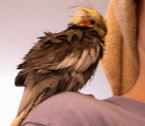
One week ago, my partner and I met with a woman who lives nearby. She breeds birds, mostly parrots. We were interested in a hand-fed budgerigar (parakeet) she had for sale.
She gave us the pitch for the local bird club, told us about the need for foster homes for large parrots, and gave us a brief tour of the birds she owns. We handled the bird we were interested in. Before we put him in our carrier, she made sure his wings were safely clipped (we don't want any escapee parrots!) and trimmed his nails.
There was a moment when we were all staring at the bird's little feet kicking in the air near the nail clippers. She looks at us and says, "You know that birds are like potato chips." I must have looked pretty blank. She went on, "You can't stop with just one."
I laughed. This purchase brought our parrots to four; we will always remember two others that have passed away. It is a joy to interact with them, and to watch them interact with each other. I was especially grateful for their presence when I was fighting cancer.
No, I thought, I could not imagine having stopped with just one.
Tuesday, October 12, 2010
Holy nickname
Last spring, my bible study group read the Song of the Sea - what the Israelites sang after crossing the parted sea while fleeing the Egyptians. One thing that caught my attention was the nickname "Yah" used in the song. It is, the commentary explained, an abbreviation of the YHWH formal name of God.
It made something click for me in the worship services: Halleluyah. Learning it growing up in a Protestant church, and seeing it used in novels, I had always thought of it as just a word of praise. The past six years of attending worship services that include Hebrew let me realize that Hallelu is a Hebrew word: Let us praise. And "yah" is a nickname for God.
The name YHWH used to be pronounced by the High Priest inside the Temple during the High Holy Day services. Two thousand years ago, the Temple was destroyed and the office of High Priest was discontinued. The prohibition on saying the name outside that specific circumstance is such that the vowels and pronunciation have been lost. The Bible records an instance of the death penalty being imposed for inappropriately speaking the name YHWH (Leviticus 24:10-23).
And yet, there is this nickname. A nickname so pervasive that it is part of the most common praise for the Lord. Halleluyah. Holy nickname.